“Having a national competency-based framework that is recognized and accepted in multiple jurisdictions does a tremendous job of moving us forward.”

Dr. Gordon McDonald, Palliative Care Physician, New Brunswick

“Having a national competency-based framework that is recognized and accepted in multiple jurisdictions does a tremendous job of moving us forward.”

Dr. Gordon McDonald, Palliative Care Physician
New Brunswick

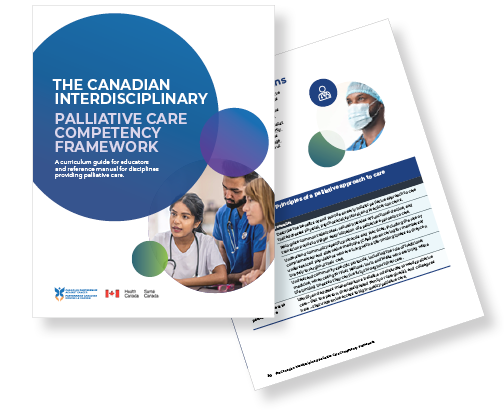
The Canadian Interdisciplinary Palliative Care Competency Framework

Supporting the person as a whole

It can be challenging to achieve consistency across care settings and across the various disciplines that may be involved. This is compounded when caring for people in rural and remote locations who must travel to larger cities for tertiary care and/or who receive home care services that can be constrained by distance.

To be effective, all members of the interdisciplinary team must have a degree of comfort in navigating palliative care conversations, being present and able to support the whole person. The Competency Framework serves as a unifying tool across, and within, disciplines. Knowing that the members of the health care team are working at the generalist or specialist level of the national set of competencies provides confidence and assurance of an aligned approach to care and conversation, whether in hospital, in hospice or in the home.


A foundational resource
The Competency Framework is a great foundational point for developing the skill set that people providing palliative care need. It is a basis for jurisdictions without guides and a complement to those with provincial frameworks. It is a starting point for the members of the care team to support the person beyond symptom management and medication options, toward supporting the person in the context of their palliative experience. Clinicians, despite their busy schedules and concerns for the management of the patient’s physical needs, typically welcome the opportunity to learn how to effectively manage the challenging conversations of palliative care.

Hospitalization is not necessarily a failure
A frequent discussion is about patients’ desire to die at home. Clinicians strive to enable that aspiration for as long as care needs can be met. Many people are fortunate to have the support of family and community members who desperately try to avoid hospitalization, not wanting to fail their loved one. However, hospitalization for patients at end-of-life is appropriate and necessary in some circumstances, for a variety of important concerns. Hospitalization is often the achievement of a competent palliative care team having kept the patient at home for as long as needs can be met and recognizing the patient’s best interests.

More than half of Canadians die at home or in the community (54.5%) rather than in hospital.

Dr. Gordon McDonald is a Palliative Care Physician, husband and father in Fredericton, New Brunswick. He practiced in Family Medicine for 11 years before moving to full-time palliative medicine and has enjoyed the opportunity to work with the Canadian Society of Palliative Care Physicians (CSPCP) Board of Directors since 2021. His work has allowed him to support many of the rural communities and teams of health care practitioners in the delivery of palliative care in hospitals, at home and in Fredericton’s residential hospice.

This project has been made possible through a financial contribution from Health Canada. The views expressed herein do not necessarily represent the views of Health Canada.

Jeffrey Moat, Chief Executive Officer PALLIUM CANADA

This post is also available in: French