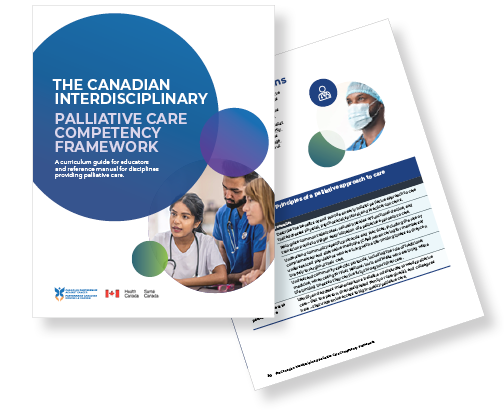
“People in Canada want and deserve highly skilled providers able to provide palliative care that supports their physical, psychosocial and spiritual needs. The Canadian Interdisciplinary Palliative Care Competency Framework establishes a minimum pan-Canadian standard to ensure healthcare providers have knowledge and skill to deliver quality palliative care that helps people live more fully, and more comfortably throughout their cancer journey.”

Erika Nicholson, Vice President, Cancer Control
CANADIAN PARTNERSHIP AGAINST CANCER

“People in Canada want and deserve highly skilled providers able to provide palliative care that supports their physical, psychosocial and spiritual needs. The Canadian Interdisciplinary Palliative Care Competency Framework establishes a minimum pan-Canadian standard to ensure healthcare providers have knowledge and skill to deliver quality palliative care that helps people live more fully, and more comfortably throughout their cancer journey.”

Erika Nicholson, Vice President, Cancer Control
CANADIAN PARTNERSHIP AGAINST CANCER

The History Behind the Canadian Interdisciplinary Palliative Care Competency Framework

The Canadian Partnership Against Cancer’s Vision for the Competency Framework—Today and Tomorrow

Formally launched in October 2021, the Canadian Interdisciplinary Palliative Care Competency Framework  (the Competency Framework) reflects years of collaboration among palliative care experts, governments, Canadians with lived experience and stakeholder organizations. This collaboration—in addition to the history behind the Competency Framework’s development—is an essential part of its value.

The Competency Framework’s roots began in 2017 when the Parliament of Canada passed Bill C-277. This legislation called for better access to palliative and end-of-life care in community and home settings. It also called on the federal government to work with the provinces and territories, as well as palliative care experts, to develop a structure that guides and supports the implementation of high-quality palliative care.

In response to the legislation, and after extensive consultation with the provinces and territories, experts and stakeholders, Health Canada developed the Framework on Palliative Care in Canada (2018) and the Action Plan on Palliative Care (2019).  The Action Plan called for the development of a pan-Canadian, interdisciplinary palliative care framework that documents essential skills, knowledge and abilities for health care providers. In response to this call to action, the Canadian Partnership Against Cancer (the Partnership) worked closely with Health Canada and countless stakeholders—including the Canadian Home Care Association—to develop the Competency Framework.


Development of the Competency Framework

The Palliative and End-of-Life Care (PEOLC) National Network led the development of the Competency Framework, with representatives from across Canada including government, palliative care organizations, cancer agencies and Canadians with lived experience. Another working group—comprised of the Partnership, Health Canada, Pallium Canada and the BC Centre for Palliative Care—dedicated the resources required for adaptation. This included adapting the five existing provincial frameworks and working with the Canadian Society of Palliative Care Physicians to develop the physician competencies.

Hundreds of individuals, patients and families, experts and organizations contributed to the development of the Competency Framework. The Framework has also received endorsements from over 20 national and provincial/territorial palliative care, health care and home care organizations. This incredible collaboration across Canada and across disciplines has enabled the creation of a framework that can be used consistently as the common vision, driving the standard for palliative care across jurisdictions.

Meeting the needs of palliative care patients, families and health care providers

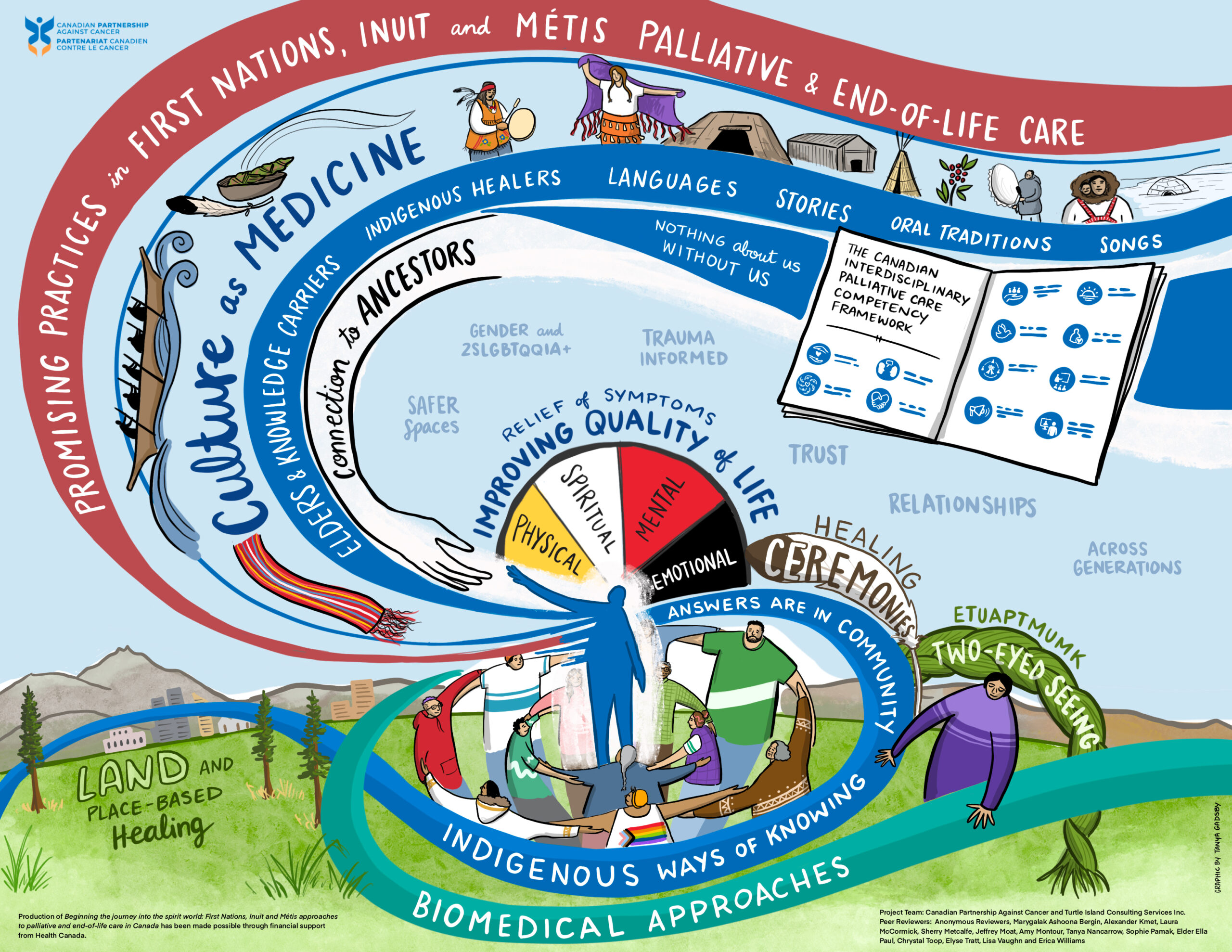
Today, organizations, agencies and educators are using the Competency Framework to guide the development of curriculum, support professional development and onboarding, and conduct environmental scans. The Partnership is continuing in its role as facilitator and convener to encourage the broad adoption of the Competency Framework, producing an additional comprehensive resource, Beginning the journey into the spirit world: First Nations, Inuit and Métis approaches to palliative and end-of-life care in Canada. This resource and accompanying infographics summarize factors contributing to palliative and end-of-life care experiences, best and promising practices and community-based models of care for First Nations, Inuit and Métis Peoples. Looking forward, there are plans to continue engaging with partners and stakeholders to integrate feedback into future iterations of a framework that meets the needs of palliative care patients, families and health care providers tomorrow.

The description of the competencies required of home-based palliative care providers includes 12 main categories and 47 subcategories

The Canadian Partnership Against Cancer  was created by the federal government in 2006 with funding through Health Canada to work with Canada’s cancer community to implement the Canadian Strategy for Cancer Control to ensure fewer people get cancer, more people survive cancer, those living with the disease have a better quality of life and all people in Canada have equitable access to quality cancer care.

This project has been made possible through a financial contribution from Health Canada. The views expressed herein do not necessarily represent the views of Health Canada.

Jeffrey Moat, Chief Executive Officer PALLIUM CANADA

This post is also available in: French