“The power of the Competency Framework is in the lack of specificity.”

Pablita Thomas, Executive Director
BC Hospice Palliative Care Association

“The power of the Competency Framework is in the lack of specificity.”

Pablita Thomas, Executive Director
BC Hospice Palliative Care Association

Sustaining the Competency Framework for Better Palliative Care

Evaluation, feedback and sharing will be key

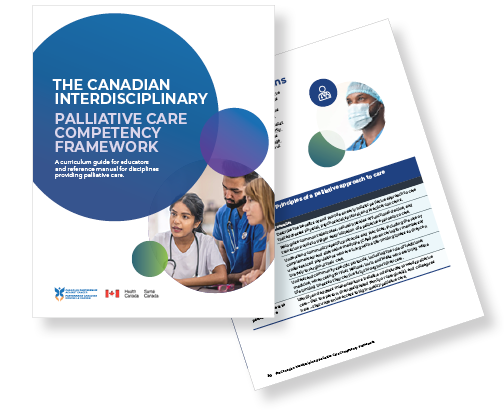
The Canadian Interdisciplinary Palliative Care Competency Framework (the Competency Framework) contributes to palliative care through its focus on the intersection of health care provider knowledge, skill and attitude. As a national framework, it respects the variation across the country, providing a tool that complements regional and/or local approaches.

The Competency Framework organizes palliative competencies into 12 domains to help everyone in the circle of care understand practice from a broader scope and within the context of a specialist or a generalist. This is a welcome methodology, and in many ways incorporates a more inclusive approach, for the medical model in which most of health care practice in Canada operates.

For BCHPCA, the Competency Framework will allow us to strengthen the collaboration between our patient-facing volunteers, who provide a significant amount of care in the community, and the rest of the interdisciplinary care team. Even team members who are not expressly listed in the Framework can consider and develop their competencies through the reflections prompted by the document. The Framework furthers our palliative care services and, ultimately will support the creation of an accreditation program for hospice organizations.

From an advocacy perspective, the Framework demonstrates to government that there is a core level of understanding of practice—not only provincially but nationally as well. Given the expectations of an aging population and the accountability metrics that command government attention, the Framework must be a welcome contribution to leveraging capacity to provide competent palliative care at home. It supports the work of government to better equip our interdisciplinary team—particularly home support, where there is a huge gap in palliative education and competency development.

Evaluation of the Framework will be vital to keep the work alive and in use. It will also be helpful to learn about the experiences of others using the tool. Early assessments could be on the level of engagement and the manner of use in palliative care settings. Potentially, an Agree Tool process could be used to assess quality of service and what works, or not, by region or team, for example. Leadership will need to support use of the tool by giving people space and time to review their competencies and reflect on their own strengths and learning needs. Perhaps, as in other sectors, a surveyor would be useful to observe and offer strategies for how to apply the Competency Framework.


86% of respondents in a 2016 survey called for national standards to be developed and implemented by the federal government.

Palliative Care Matters. News Release – Ipsos Survey Report: Canadians Strongly Support Access to High Quality Palliative Care. 2016. http://www.palliativecarematters.ca/news-collection/2016/10/18/ipsos-survey-results-infographic


The BC Hospice Palliative Care Association is a not-for-profit, charitable, public membership organization which has been representing individuals and organizations committed to promoting and delivering hospice palliative care to British Columbians and Yukoners for over 37 years. Our members provide a broad range of hospice palliative care programs and services to people in need across the province of BC and the Yukon territories with serious illnesses, their loved ones who are grieving, and their caregivers. The services hospice societies deliver are accessible to all, regardless of illness, age, sex, sexual orientation, race, culture, and religious beliefs

This project has been made possible through a financial contribution from Health Canada. The views expressed herein do not necessarily represent the views of Health Canada.

Jeffrey Moat, Chief Executive Officer PALLIUM CANADA

This post is also available in: French