



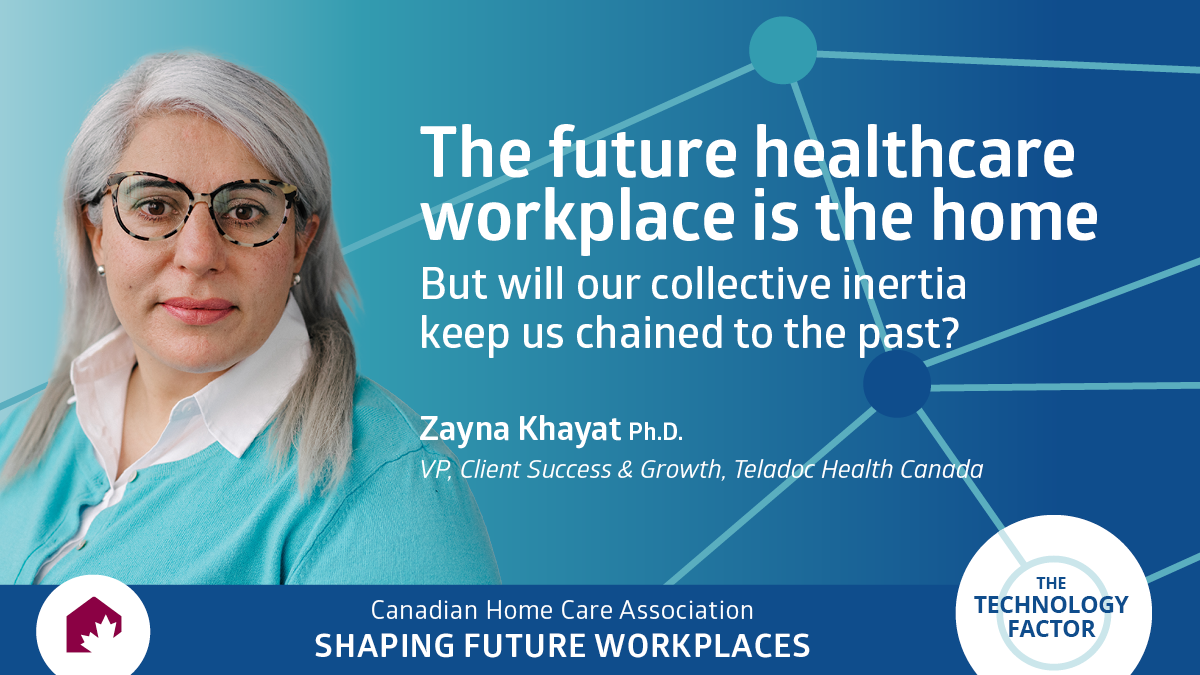
• Zayna Khayat, Ph.D.

    VP, Client Success & Growth, Teladoc Health Canada
    Adjunct Professor, Health Sector Strategy, Rotman School of Management, University of Toronto
    Senior Advisor/Futurist, Deloitte Canada, Life Sciences & Healthcare

    Feb 6, 2023
    Read time = 4 minutes

The future healthcare workplace is the home

But will our collective inertia keep us chained to the past?

Three forces are collectively shifting the center of gravity for healthcare delivery. The first is pull from patients and their families who seek to heal in the place of their choice; for many that is the home. The second is the chronic shortage of capacity in clinics, hospitals, and nursing home facilities.  And the final force is available, scaleable technology that breaks the constraints of time and place that previously have been imposed on how and where healthcare services are delivered.

Acknowledging that technology is an all-encompassing term, I suggest three different ways technology solutions are enabling healthcare at home, at population, and at system scale.

The first is using technology to enable business process optimization – to eliminate much of the waste, duplication, redundancy, and cost associated with the largely analog and often paper-based processes of today.  No more faxes, no more emails that are printed, no more paper forms, paystubs, invoices and so on.  Picture automated scheduling that is communicated via mobile devices in the hands of all staff; or electronic referrals and charting that is accessible across the health care team.

This automation is straightforward and in of itself could “save” a lot of the unsustainable costs of healthcare. The challenge is not the technology but rather the commitment to make it happen. Any other industry, that fails to use technology for basic modernization of operations like this would be out of business. Further, the popular media suggests that boomers will not tolerate less than this type of frictionless experience when they receive care services in their homes.

The second bucket of technology application is more value-creating – enabling more intelligent care based on harnessing data and analytics for faster cycles of learning, planning, and performance management. This will only be possible as digitalization of previously analog care processes produces a data exhaust that objectively informs practice as opposed to the subjective anecdote of the visit. An intelligence-based home care system is created where data helps inform, at an individual level, what to do and not to do, and what’s safe and not safe – as opposed to outdated guidelines designed for an entire population. This provides the ability to make smarter choices, in real time, regarding practice and policy and ultimately improving day-to-day care, patient and clinician experience. As during the pandemic, good data can provide compelling evidence to act, in near real time. [i]

The third bucket of opportunities from harnessing emerging technology for healthcare at home is a bit more futuristic. It is where next practices and care models emerge that are not so implausible technically but significant in the potential to fundamentally shift the status quo of institution-focused care models into the home setting.  Technology will enable better/faster/cheaper dialysis at home, chemo at home, and most diagnostic tests at home. Medications will primarily come from a central facility where robots fulfill prescriptions that are delivered directly to the home via delivery services including drones. The next step will be 3D printed production of medications at home.  Imaging is another technology that is becoming more mobile and democratized. Portable ultrasound and MRIs are available now and soon will be in the hands (pockets!) of home care clinicians. Essentially, care of nearly any acuity can and will be done at home, with the emerging technology stack.

The three streams of technology described above have great potential to create an amazing experience for patients while extending the capacity of home care and the broader health care system, freeing up scarce health human resources for those with the greatest need.

With the technology essentially in place and moving in the right direction, the challenge and opportunity becomes disintermediation – allowing the customer direct access to the most appropriate service or good, from the most appropriate care provider, in the most appropriate setting of their choice. In health care this is always in the context of those who are able (e.g. clients who cannot manage chemo or dialysis at home, do not have to).  The next level of disintermediation is the elimination of the professional as people feel comfortable self-managing, with the help of their family and community.

IN SUMMARY

The future potential of technology as healthcare shifts out of institutions and into the home will extend our capacity to care for citizens and change the role of place in human interventions in health care. It offers the antithesis to the current state where people at all levels of health care from the frontline to the c-suite and government are heavily invested – intellectually, financially, and emotionally.    The question remains as to whether we can dismantle and rebuild from within or whether the new and emerging disruptors will take the lead.

References

[i]Isaacksz, S. Bridging the Digital Divide in Community – Lessons from the pandemic, Shaping Future Workplaces – The technology Factor. Insights And Experiences. Canadian Home Care Association, November 2022
 https://cdnhomecare.ca/bridging-the-digital-divide-in-community-lessons-from-the-pandemic/

ABOUT THE INITIATIVE

In response to the trends impacting the labour market, the Canadian Home Care Association (CHCA) has launched an initiative to share ideas on how to design, establish and maintain great workplaces where employees are valued, respected, and nurtured. The current campaign, launched in September 2022, features the technology factor, and explores the impact and potential of technology in home care today and in the future. The discussions and campaign content will feature research evidence, lived experiences and opinion leaders’ thoughts on how technology is shaping the future workplaces in home and community care across the country.

#decisionintelligence    #distributedenterprise.   #totalexperience

  • Zayna Khayat, Ph.D.

    VP, Client Success & Growth, Teladoc Health Canada
    Adjunct Professor, Health Sector Strategy, Rotman School of Management, University of Toronto
    Senior Advisor/Futurist, Deloitte Canada, Life Sciences & Healthcare

    Feb 6, 2023
    Read time = 4 minutes

The future healthcare workplace is the home

But will our collective inertia keep us chained to the past?

Three forces are collectively shifting the center of gravity for healthcare delivery. The first is pull from patients and their families who seek to heal in the place of their choice; for many that is the home. The second is the chronic shortage of capacity in clinics, hospitals, and nursing home facilities.  And the final force is available, scaleable technology that breaks the constraints of time and place that previously have been imposed on how and where healthcare services are delivered.

Acknowledging that technology is an all-encompassing term, I suggest three different ways technology solutions are enabling healthcare at home, at population, and at system scale.

The first is using technology to enable business process optimization – to eliminate much of the waste, duplication, redundancy, and cost associated with the largely analog and often paper-based processes of today.  No more faxes, no more emails that are printed, no more paper forms, paystubs, invoices and so on.  Picture automated scheduling that is communicated via mobile devices in the hands of all staff; or electronic referrals and charting that is accessible across the health care team.

Imagine a home care nurse, receives an electronic referral for a new client and can immediately advise the client through an app of the time of the first/next visit. Upon arrival the care exchange is noted in a cloud-based documentation system, which is prepopulated with the requisite history and information including physician orders and a list of other services that have been scheduled. The nurse’s notes from the visit are immediately accessible by the client, consented family members and the care team. The nurse’s order for supplies is sent for processing before leaving the house – the client is alerted to when they will arrive, and the nurse also receives notification of delivery.  Finally, the mileage to get to/from the home is calculated so that nurse can be paid – the same day – for travel time and fuel charges based on the prices of that day.

This automation is straightforward and in of itself could “save” a lot of the unsustainable costs of healthcare. The challenge is not the technology but rather the commitment to make it happen. Any other industry, that fails to use technology for basic modernization of operations like this would be out of business. Further, the popular media suggests that boomers will not tolerate less than this type of frictionless experience when they receive care services in their homes.

The second bucket of technology application is more value-creating – enabling more intelligent care based on harnessing data and analytics for faster cycles of learning, planning, and performance management. This will only be possible as digitalization of previously analog care processes produces a data exhaust that objectively informs practice as opposed to the subjective anecdote of the visit. An intelligence-based home care system is created where data helps inform, at an individual level, what to do and not to do, and what’s safe and not safe – as opposed to outdated guidelines designed for an entire population. This provides the ability to make smarter choices, in real time, regarding practice and policy and ultimately improving day-to-day care, patient and clinician experience. As during the pandemic, good data can provide compelling evidence to act, in near real time. [i]

The third bucket of opportunities from harnessing emerging technology for healthcare at home is a bit more futuristic. It is where next practices and care models emerge that are not so implausible technically but significant in the potential to fundamentally shift the status quo of institution-focused care models into the home setting.  Technology will enable better/faster/cheaper dialysis at home, chemo at home, and most diagnostic tests at home. Medications will primarily come from a central facility where robots fulfill prescriptions that are delivered directly to the home via delivery services including drones. The next step will be 3D printed production of medications at home.  Imaging is another technology that is becoming more mobile and democratized. Portable ultrasound and MRIs are available now and soon will be in the hands (pockets!) of home care clinicians. Essentially, care of nearly any acuity can and will be done at home, with the emerging technology stack.

The three streams of technology described above have great potential to create an amazing experience for patients while extending the capacity of home care and the broader health care system, freeing up scarce health human resources for those with the greatest need.

With the technology essentially in place and moving in the right direction, the challenge and opportunity becomes disintermediation – allowing the customer direct access the most appropriate service or good, from the most appropriate care provider, in the most appropriate setting of their choice. In health care this is always in the context of those who are able (e.g. clients who cannot manage chemo or dialysis at home, do not have to).  The next level of disintermediation is the elimination of the professional as people feel comfortable self-managing, with the help of their family and community.

IN SUMMARY

The future potential of technology as healthcare shifts out of institutions and into the home will extend our capacity to care for citizens and change the role of place in human interventions in health care. It offers the antithesis to the current state where people at all levels of health care from the frontline to the c-suite and government are heavily invested – intellectually, financially, and emotionally.    The question remains as to whether we can dismantle and rebuild from within or whether the new and emerging disruptors will take the lead.

References

[i]Isaacksz, S. Bridging the Digital Divide in Community – Lessons from the pandemic, Shaping Future Workplaces – The technology Factor. Insights And Experiences. Canadian Home Care Association, November 2022

 https://cdnhomecare.ca/bridging-the-digital-divide-in-community-lessons-from-the-pandemic/

ABOUT THE INITIATIVE

In response to the trends impacting the labour market, the Canadian Home Care Association (CHCA) has launched an initiative to share ideas on how to design, establish and maintain great workplaces where employees are valued, respected, and nurtured. The current campaign, launched in September 2022, features the technology factor, and explores the impact and potential of technology in home care today and in the future. The discussions and campaign content will feature research evidence, lived experiences and opinion leaders’ thoughts on how technology is shaping the future workplaces in home and community care across the country.