


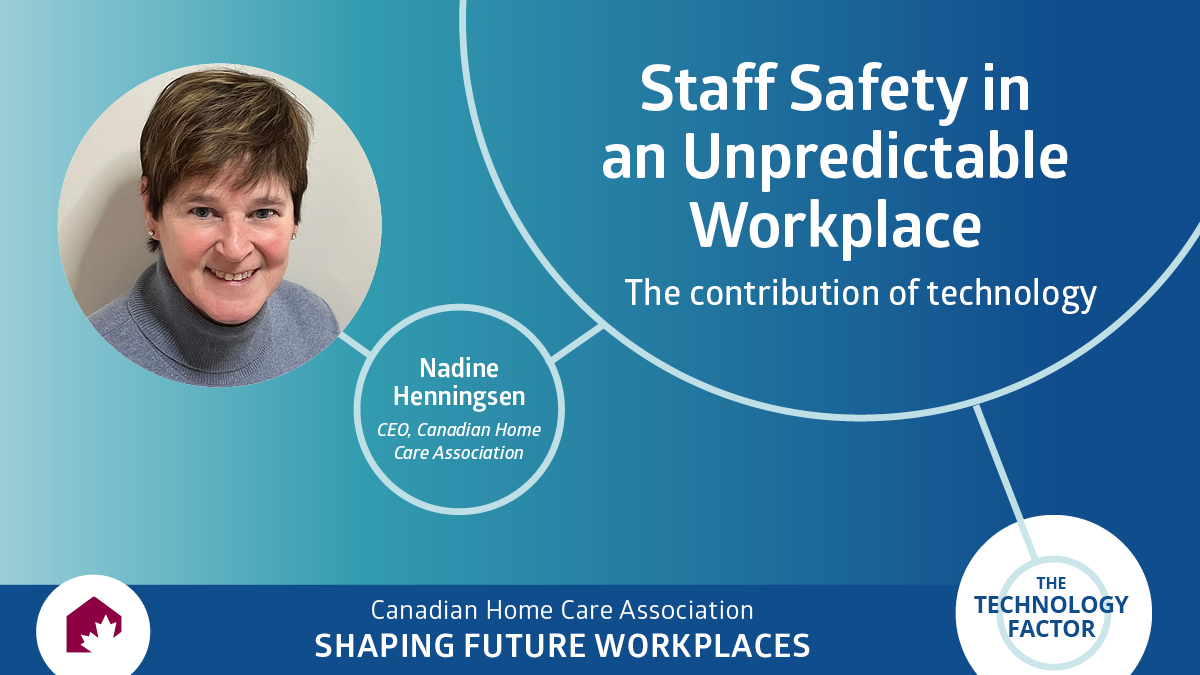
“Technology has had a huge impact on how we work and connect. From social media to regular video-conferencing with stakeholders across Canada and internationally, the CHCA team is embracing new ways to work using technology”
Twitter: @CdnHomeCare
Linkedin: @canadian-home-care-association
Staff Safety in an Unpredictable Workplace
The contribution of technology
Health care providers must balance a safe working environment with respecting an individual’s preferences and rights when delivering health care services in the home and community. Providing care in these workplaces can pose many safety challenges.
Clinicians delivering home and community-based services must be equipped with the knowledge and skills to adapt to different environments while considering the safety of the client, their families and health care team members. Providing care in less-than-ideal home environments and working alone with minimal control over the environment, not to mention travelling in potentially hazardous weather conditions or unsafe neighbourhoods, can be threatening for home care staff. As a result, staff need to have a level of experience, confidence and competence to deal with these uncertain situations.
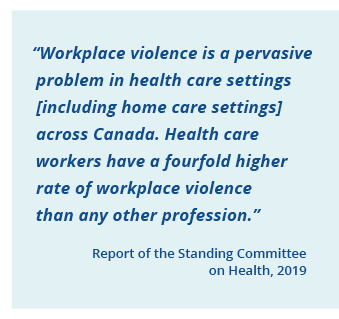 Supporting employees’ psychological and physical well-being when delivering care in unpredictable and irregular environments is a priority for all employers in the home care sector. Employers’ safety strategies and programs have evolved over time and have been impacted by new technologies.
Prior to the 1990s, staff visits were conducted in pairs to enhance worker safety in potentially dangerous situations. In the 1990s, computerized scheduling and the use of telephones enabled real-time tracking of staff though a “check-in” and “check out” process. While some workers felt the tracking to be invasive, a large percentage of staff recognized the benefit of increased personal safety. As a result, they felt more confident knowing their locations were monitored and responses to unplanned events could be quickly deployed. If a staff member was delayed in arriving or leaving a client’s home, the employer was able to call to confirm that all was well or to determine if they needed to send support into the community.
In the mid-2000s, smartphones with embedded GPS facilitated access to and from staff via voice or video and enabled employers to dispatch help to the precise location of need. With the reduction of cellular costs and more workers using their own devices at work, these employee location tracking capabilities are now commonplace for most home care employers.
As technology evolves, the use and sophistication of sensors and artificial intelligence (AI) continue to improve staff and client safety. Devices can be configured to detect and alert the employer of problems in the community and establish two-way, hands-free conversations with staff. Employers can now leverage AI technologies as part of their Personal Safety Response Systems for employees. This allows them to interpret data from multiple sources to improve accuracy and reduce false alarms. Whether clinicians have an ailment, experience a vehicle breakdown or feel personally threatened, innovative technology allows employers to readily communicate and respond to these challenging situations.
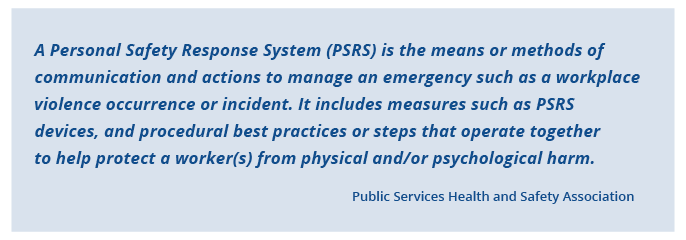
Technology is one part of an effective workplace safety plan that must include establishing a culture of safety, providing clear policies and procedures, and strongly committing to employee safety. Attracting and retaining health care providers in the home care sector require measures that prioritize workers’ safety. Through robust health and safety programs and the use of innovative technology, employers in the home care sector can provide workers with the knowledge, skills and support systems to identify, respond to and de-escalate potential safety challenges in the home and community.
References
Chandrashekar, P., Moodley, S., & Jain, S. H. (2019, October 17). 5 Obstacles to Home-Based Health Care, and How to Overcome Them. Harvard Business Review. Retrieved on October 28, 2022, from https://hbr.org/2019/10/5-obstacles-to-home-based-health-care-and-how-to-overcome-them
Public Services Health and Safety Association. (2017). Personal Safety Response Systems Resource Manual. Retrieved on October 18, 2022, from https://workplace-violence.ca/wp-content/uploads/2017/06/Personal-Safety-Response-System-V1.2-VWVMNEEN1117-1.pdf
Kirby, L. (April 2021). Critical Safety Technologies for Your Mobile Workforce. Retrieved on October 18, 2022, from https://www.homecaremag.com/april-2021/safety-technologies-mobile-workforce
Home Care Ontario. (October 2015). Rate Framework Reform: Submission to WSIB. Retrieved on October 18, 2022, from https://www.homecareontario.ca/docs/default-source/ohca-submissions/wsib-rate-framework-reform—home-care-ontario-submission-oct-2015-final.pdf?sfvrsn=6
Standing Committee on Health. (June 2019). Violence Facing Health Care Workers in Canada. Report of the Standing Committee on Health. Retrieved on October 18, 2022, from https://www.ourcommons.ca/Content/Committee/421/HESA/Reports/RP10589455/hesarp29/hesarp29-e.pdf

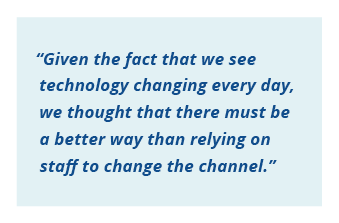 We chose a unit where young adults (under the age of 65 years) with significant physical challenges live. Their needs include assistance with activities of daily living (ADLs) and many basic physical tasks such as turning a fan on or off. We worked with Novalte, a company that focuses on technology to support personal independence (ii). The device that we introduced translates voice commands to existing equipment without the need for costly to upgrades or customizations. The technology, emitto, seamlessly connects existing smart technologies, whether infrared, blue tooth, radio frequency or WIFI, into a single platform responsive to voice commands.
