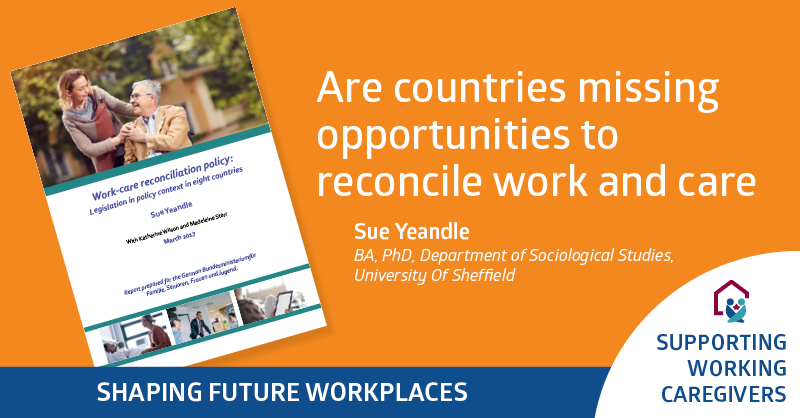
This paper highlights the context for national legislative and policy approaches to ‘work-care reconciliation’ – supporting people in employment to manage their paid work alongside a caring role – in eight countries: Australia, Canada, Finland, France, Japan, New Zealand, Sweden and the UK.
The extent to which countries have invested in developing local care services, provided allowances to carers who quit work, offered work-care reconciliation measures, or invoked human rights and non-discrimination legislation depends on its history, political complexion, and trajectory. It is also affected by how statutory, private sector and voluntary organisations interact and work with each other. International comparisons can usefully inform policy learning.
The concept of work-care reconciliation originally came into widespread use in connection with the challenges that parents (especially mothers) face in combining responsibility for childcare with paid employment. From the later 20th century, the term began also to be used in debates about how families manage the care of older relatives alongside a career or job. Today it is widely discussed, especially where female employment has become the norm alongside family roles and in the context of population ageing.
In the paper, published in 2018, eight countries were reviewed. Each had adopted some legislated measures that aimed to support working carers manage their complex roles and achieve a degree of work-care reconciliation. None, however, had opted to introduce a ‘full suite’ of the available options, such as care leaves, flexible working, job protection and pension/employment insurance protections.
Many of the measures governments introduced were modified or adapted within a few years, suggesting experimentation with the policies. Few seemed to have thought radically about how to reorganise their systems of care and support to make them more ‘carer-friendly’. Even where work-care measures were adopted, usually they were not systematically evaluated to see what difference they made, or how carers in different circumstances experienced them.
Governments need to learn from each other and to act. The report suggests countries are missing opportunities to help their citizens reconcile work and care and support their businesses to function better. Yet policy learning about work-care reconciliation across national boundaries could have real benefits for their economy, society, citizens and communities.
Some progress is being made. The German Government recently undertook a major review of this issue, publishing early findings here, And within the European Union, debate and actions are underway to effect changes, as discussed in this major exploration of ‘work-life balance’ in 2020.
Read the full report for details on the countries studied and on UK organizations tackling work-care challenges