While honouring Indigenous culture, diverse ways of knowing, and Indigenous research methods, this study was undertaken to explore the caregiving experiences of peoples who identify as First Nations, Métis or Inuit, are 18+, reside in Ontario, and work while providing care simultaneously to an adult family member or loved one. We also explored the impact of COVID-19 on caregiving- and employment- related roles and duties to better understand how to best accommodate carer-employees, provide guidance to employers, and determine necessary resources.
Though the need for family carers in Canada is increasing, the caregiving contribution fails to account for the quickly growing immigrant, visible minority, and Indigenous populations (First Nations, Métis and Inuit) who make up a great portion of unpaid carers in Canada. Specifically, Indigenous populations are growing at rates nearly four times faster than their non-Indigenous counterparts, and the portion of those living passed age 65 has increased 2.5% since 2016.[i] Aging Indigenous populations are at significantly higher risk for chronic illnesses/conditions and lack access to primary health care services. As a result, there is increased reliance on family members or loved ones for unpaid care which has been further complicated by the pandemic.
This study focuses on Indigenous transnational carer-employees (TCEs) who are identified as those who reside and work in Ontario, while simultaneously providing care to adult family members, friends or neighbors who are living with a disability or have age-related needs elsewhere or in another country/province where the impact of COVID-19 has made it exceedingly difficult for unpaid carers to provide care.
Community-based participatory methods[ii] were used with 10 Indigenous participants from across Ontario. Purposive and snowball sampling, where the researcher depends on existing research participants to help identify other potential subjects, was used for recruitment. Arts-based ethnography was used to provide context and for the purpose of thematic analysis through artwork and storytelling.


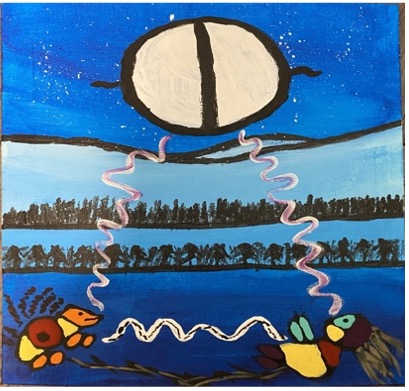 “The white wavy lines are lines of communications. This is what they represent in Woodland art. We have one line of communication directly connecting us, but we each also have a line of communication to the moon (grandmother) and that show that we also connect through spirit and prayer as we are away from each other right now. We are connected by the roots underneath us, Mother Earth” -Alexis
